
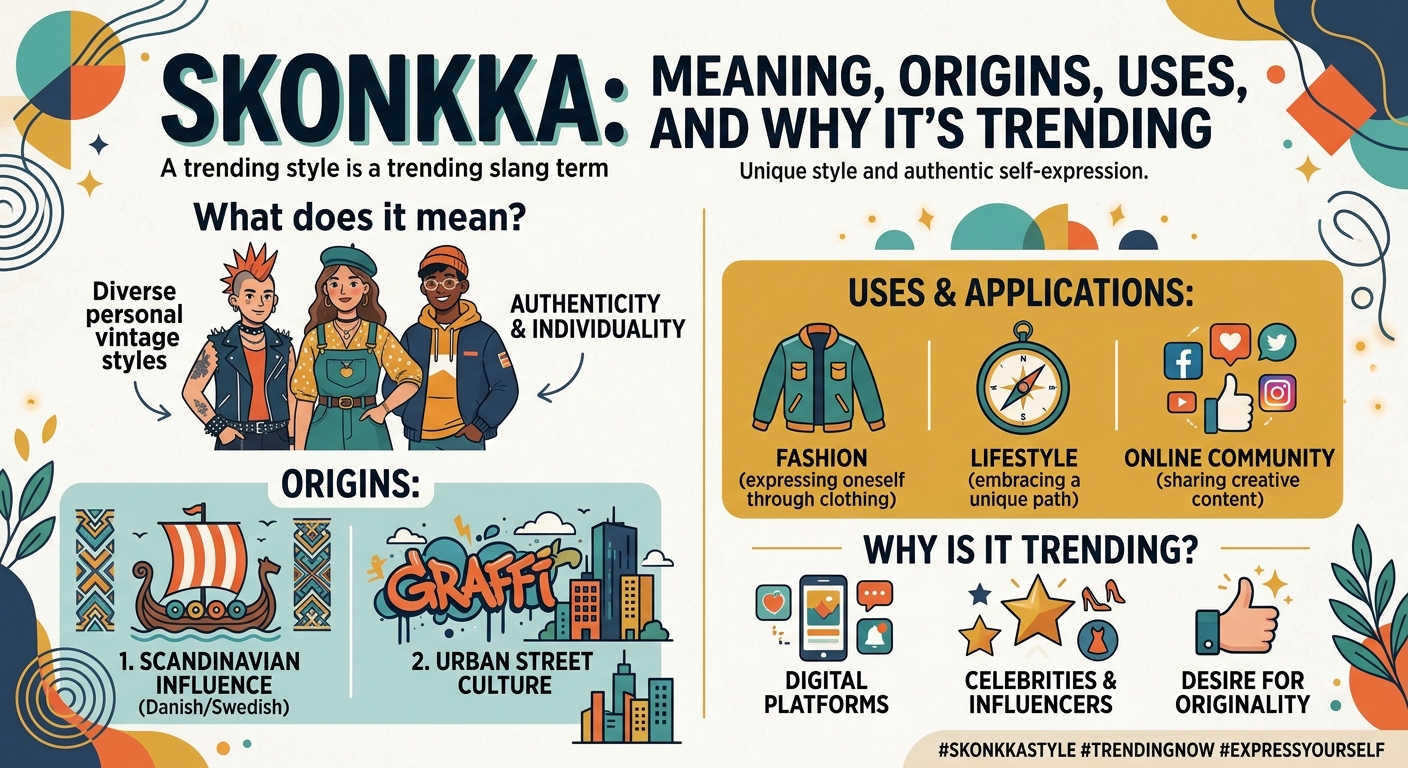
Skonkka is an unusual internet term that has attracted curiosity because its meaning is not consistent across every source or community. People searching for the word may encounter explanations describing it as slang, an internet expression, a cultural concept, or even the name of an online platform. This lack of a single accepted definition makes the term particularly interesting.
Current online discussions show that Skonkka is often treated as a flexible expression whose meaning depends heavily on context. Some recent articles describe it as playful slang connected with unusual, chaotic, or humorous behavior, while other sources associate similar spellings with older slang.
What Does Skonkka Mean?
There is no universally recognized dictionary definition for Skonkka. Unlike established English words, its meaning appears to change according to where and how it is used.
On social media, unfamiliar expressions can develop meanings through memes, comments, private communities, and repeated jokes. In this environment, a strange word does not necessarily need a formal definition before becoming recognizable.
Some contemporary online explanations use the term to describe something random, unusual, funny, or chaotic. In other contexts, related spellings have appeared as slang with derogatory meanings. Because of these differences, readers should avoid assuming that every use carries the same meaning.
The Possible Origins of Skonkka
The exact origin of Skonkka remains uncertain. There is no strong evidence establishing one universally accepted source, and several online explanations make different claims about its history.
Some modern articles connect the term with informal speech and internet communities, while others present theories involving regional slang or bilingual language.
This uncertainty is not unusual for internet vocabulary. Slang can begin inside a small social group, spread through conversations, and eventually appear on public platforms without leaving a reliable historical record.
Skonkka and Internet Culture
The growth of Skonkka demonstrates how quickly language can change online. Social networks allow users to invent expressions, remix existing words, and give familiar terms completely new meanings.
A word may first appear in a private conversation before moving into memes, comments, videos, or online communities. Once enough people encounter it, searches increase because users want to understand what they have seen.
This cycle creates a feedback loop: curiosity leads to searches, searches create more discussions, and those discussions give the word additional visibility.
How Skonkka Is Used Online
The meaning of Skonkka depends on context. A person may encounter it in a humorous caption, a comment, a discussion about slang, or an article explaining internet culture.
Some contemporary sources describe it as a flexible reaction word that can refer to something strange, unexpected, or amusing.
However, users should be careful when repeating unfamiliar slang. Words can have different meanings in different communities, and a term that seems harmless in one setting may be offensive in another.
Understanding context is therefore more important than memorizing one simple definition.
Why Skonkka Attracts So Much Curiosity
One reason Skonkka attracts attention is its unusual appearance. People naturally become curious when they encounter an unfamiliar word that does not immediately resemble standard vocabulary.
Its unusual spelling also makes it memorable. Internet culture frequently rewards words and phrases that are distinctive, easy to repeat, and suitable for humorous content.
Another factor is the mystery surrounding its origin. When people cannot find one definitive explanation, they are more likely to search for the term and compare different interpretations.
Skonkka and Changing Digital Language
The story of Skonkka reflects a broader transformation in modern language. Traditionally, words became established through literature, journalism, dictionaries, and everyday speech. Today, digital communities can influence vocabulary at an extraordinary speed.
Memes, short-form videos, online forums, and group chats all contribute to this process. A phrase can become recognizable long before linguists or dictionaries formally document it.
This means internet language is often temporary. Some expressions disappear after a few months, while others become lasting parts of everyday communication.
Different Interpretations of Skonkka
A major challenge when researching Skonkka is the existence of conflicting explanations.
| Context | Possible Interpretation |
|---|---|
| Internet slang | A playful or unusual expression |
| Meme culture | A humorous reaction to something strange |
| Casual conversation | A context-dependent slang term |
| Older slang references | Potentially derogatory usage |
| Online articles | A cultural or linguistic concept |
These differences show why context matters. A search result alone may not provide enough information to determine what a particular speaker intended.
Older user-generated slang references also contain offensive language and should not automatically be treated as authoritative definitions.
Is Skonkka a Real Word?
Whether Skonkka qualifies as a “real word” depends on how the term is being defined. It is clearly used as a written expression online, but that does not mean it has a standardized dictionary definition.
Many slang expressions begin outside formal dictionaries. If a community repeatedly uses a term and gives it a recognizable meaning, it can function as language even before official dictionaries acknowledge it.
For now, the safest approach is to describe Skonkka as an informal and context-dependent term rather than a standard English word.
The Future of Skonkka
The future of Skonkka is difficult to predict. Internet trends can disappear quickly, but some unusual expressions survive because they are adaptable.
If users continue incorporating the word into memes, discussions, videos, or creative communities, its meaning may become more established. Alternatively, it could gradually fade as newer internet expressions take its place.
That uncertainty is part of what makes digital slang fascinating. Language is constantly being created, modified, and replaced.
Conclusion
Skonkka is an intriguing example of how modern internet language develops. Rather than having one universally accepted definition, the term appears to have several interpretations depending on the source and community using it.
Research into the word reveals a mixture of contemporary internet explanations, uncertain origins, and older slang references. The most important lesson is that unfamiliar online vocabulary should always be interpreted through context.
Whether Skonkka becomes a lasting expression or eventually disappears, its popularity highlights an important feature of digital communication: today’s internet users are not simply consuming language—they are constantly creating it.