
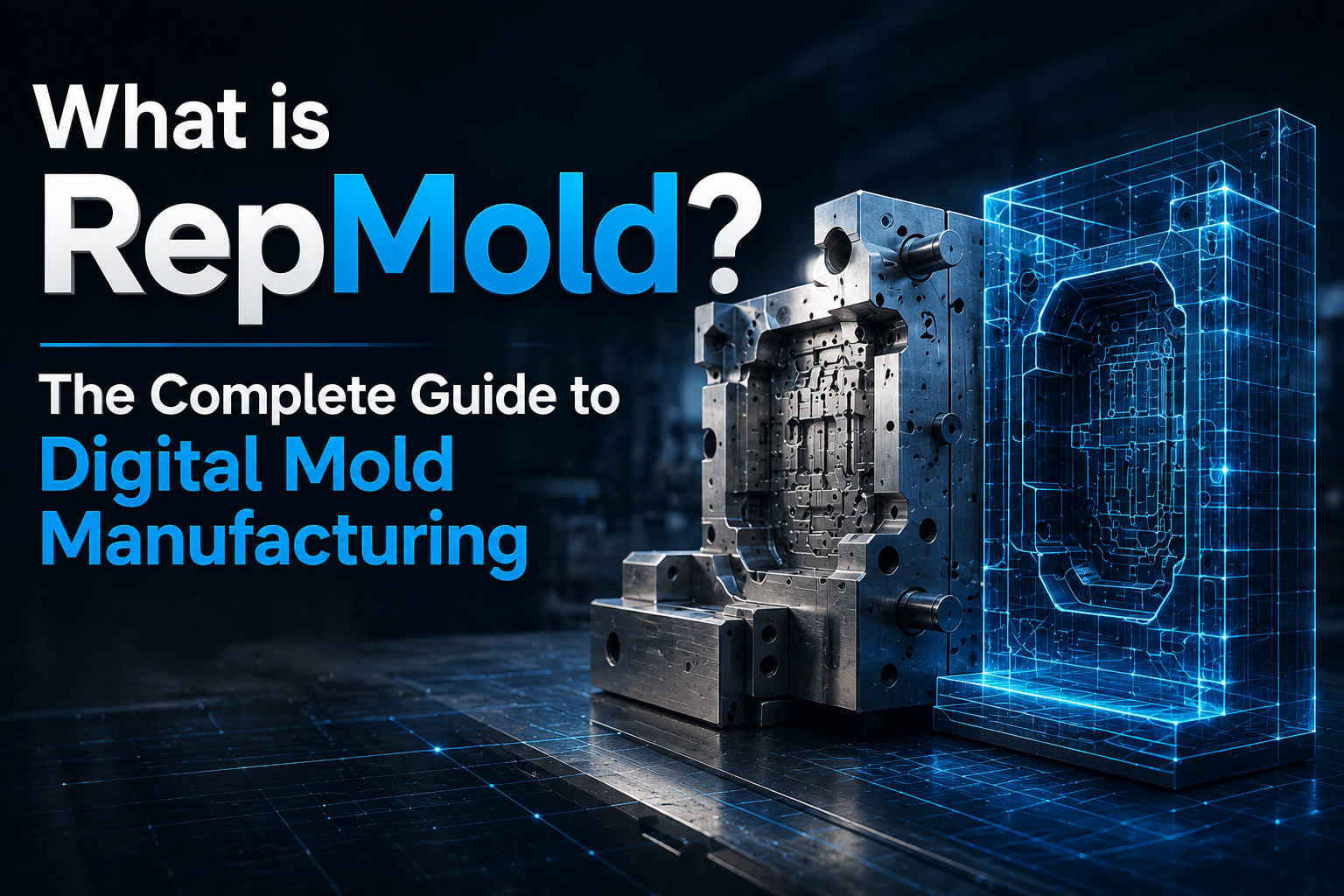
RepMold is an emerging term used to describe a digital-first approach to mold design, replication, repair, and manufacturing. Rather than depending entirely on traditional manual tooling, the approach can combine technologies such as 3D scanning, CAD modeling, simulation, 3D printing, CNC machining, and digital inspection.
One important point is that “RepMold” does not currently appear to have one universally accepted technical definition. Different sources use the term for digital mold replication, rapid tooling, mold repair, or broader digitally connected mold-production workflows.
That distinction matters because RepMold is better understood as an emerging manufacturing concept or workflow, rather than assuming it is one particular machine, software package, or standardized manufacturing process.
What Is RepMold?
RepMold refers to a modern approach to mold manufacturing that uses digital design, computer-controlled production, and advanced manufacturing technologies to create molds more efficiently than traditional methods. The concept combines digital modeling with processes such as CNC machining, 3D printing, rapid prototyping, and computer-aided manufacturing.
In traditional mold production, manufacturers often spend significant time designing, machining, testing, and modifying physical tooling. Digital mold manufacturing changes this workflow by allowing engineers to create and modify mold designs digitally before production begins. This can reduce development time, improve design accuracy, and make it easier to produce customized molds.
Although the term RepMold can be used in different contexts, it is best understood as a digital mold-making concept rather than a single manufacturing machine or universal technology. Its exact meaning can depend on the company, platform, or manufacturing process using the term.
How Does Digital Mold Manufacturing Work?
Digital mold manufacturing begins with a three-dimensional computer model. Engineers typically use CAD software to create the geometry of the mold and the product that the mold will produce. The digital model can then be inspected for dimensions, tolerances, wall thicknesses, draft angles, and other manufacturing requirements.
Once the design is approved, manufacturing software converts the digital information into instructions for production equipment. Depending on the application, the mold may be manufactured using CNC machining, additive manufacturing, or a combination of technologies.
After production, the mold is inspected and tested. If problems appear during testing, engineers can return to the digital model, make adjustments, and manufacture an updated version. This digital feedback loop is one of the major advantages of modern mold production.
The Role of CAD in RepMold Manufacturing
Computer-aided design is one of the most important parts of digital mold manufacturing. CAD allows designers to build highly detailed three-dimensional models before any physical material is cut or printed.
A digital mold model can contain information about cavities, cores, channels, surfaces, openings, inserts, and other components. Engineers can also simulate how parts will fit together and identify potential problems during the design stage.
Because changes can be made digitally, manufacturers can experiment with different designs without immediately producing expensive physical prototypes. This is particularly useful when developing new products or customized components.
RepMold and 3D Printing
3D printing has become an important technology in digital mold manufacturing because it can create complex shapes that may be difficult or expensive to produce using conventional machining.
Depending on the material and manufacturing requirements, additive manufacturing can be used to create prototype molds, patterns, inserts, tooling components, and even production molds for certain applications.
One major advantage is speed. A digital design can be sent to a suitable 3D printer and transformed into a physical object without requiring the same sequence of cutting operations used in conventional manufacturing.
However, 3D-printed molds are not automatically suitable for every production environment. Temperature resistance, mechanical strength, surface quality, dimensional stability, and expected production volume must all be considered before selecting a material and printing method.
CNC Machining in Digital Mold Production
CNC machining remains an important method for producing high-quality molds. Unlike additive manufacturing, CNC machining removes material from a block of metal, plastic, or another suitable material.
Modern CNC equipment can produce highly accurate mold components when the correct tooling, machine settings, and materials are used. Metals such as aluminum and steel are commonly considered when molds require durability and resistance to repeated production cycles.
Digital mold workflows make CNC manufacturing more efficient because the CAD model can be transferred into CAM software, where machining strategies and toolpaths are generated.
This connection between CAD, CAM, and CNC equipment creates a streamlined manufacturing process in which digital information moves from design to production with fewer manual steps.
Key Benefits of RepMold
One of the biggest advantages of digital mold manufacturing is shorter development time. Traditional molds can require substantial design and machining work, particularly when several revisions are needed. Digital workflows make modifications easier to manage.
Another important benefit is design flexibility. Engineers can create complex geometries and quickly test different versions of a mold. This can be especially valuable for product development, prototypes, and customized manufacturing.
Digital production can also improve repeatability. Once a digital design has been validated, the same design can be used to manufacture replacement components or additional molds.
Cost savings can also occur, although they depend heavily on the mold’s complexity, material, production volume, and manufacturing technology. Digital workflows may reduce prototyping and labor costs, but high-end equipment and specialized materials can still represent significant investments.
RepMold and the Future of Manufacturing
The broader trend behind RepMold is much bigger than the term itself.
Manufacturing is increasingly moving toward digital continuity, where product information remains connected from initial design through simulation, production, inspection, and future maintenance.
A mold can become more than a physical object. Its digital model can contain information about its dimensions, revisions, inspection results, production history, and maintenance requirements.
Artificial intelligence and automation may strengthen this process further. AI-assisted design could help identify manufacturing problems, recommend geometry changes, or optimize production parameters. Automated inspection could compare manufactured tooling with CAD data and identify deviations without relying entirely on manual measurement.
These technologies are still developing, but the direction is clear: manufacturing is becoming increasingly data-driven.
Materials Used for Digital Molds
The appropriate mold material depends on the intended application. Plastics and polymer-based materials can be useful for prototypes and low-volume applications, while aluminum may be selected when a stronger and more durable mold is required.
Steel is commonly considered for demanding production environments because of its strength and durability. Certain engineering polymers and composite materials can also be used for specialized applications.
Material selection should consider factors such as heat resistance, wear resistance, surface finish, dimensional stability, pressure, chemical exposure, and the expected number of production cycles.
Selecting the cheapest material is not always the most economical option. A material that fails quickly can increase maintenance, replacement, and production costs.
Applications of RepMold Technology
Digital mold manufacturing can be useful across numerous industries. In automotive manufacturing, it can support prototypes, tooling components, interior parts, and specialized production equipment.
Consumer-product manufacturers can use digital molds when developing products such as housings, containers, accessories, and customized components. Electronics companies may also use rapid tooling approaches during product development.
Medical-device manufacturing can benefit from digital workflows when producing specialized components and prototypes, although strict regulatory, material, and quality requirements must be considered.
Other applications include aerospace development, industrial equipment, packaging, educational prototypes, product design, and small-batch manufacturing.
Rapid Prototyping and RepMold
Rapid prototyping is one of the areas where digital mold manufacturing can provide substantial value. Product developers can move from a digital concept to a physical prototype relatively quickly.
Instead of committing immediately to expensive production tooling, a company may first create a prototype mold or tooling component. Engineers can then evaluate the resulting part and identify design problems.
This approach can help reduce the risk of discovering major issues after large investments have already been made in production tooling.
Is RepMold Suitable for Mass Production?
The suitability of a digital mold manufacturing approach for mass production depends on the technology and application.
For very high production volumes, conventional hardened steel tooling may remain the preferred solution because it can withstand extensive use. For lower-volume products, prototypes, customized parts, and certain specialized applications, digitally produced molds may offer significant advantages.
The best approach is therefore not necessarily choosing between traditional and digital manufacturing. In many cases, the most effective strategy combines both.
How Much Does Digital Mold Manufacturing Cost?
There is no single price for digital mold manufacturing. Costs can vary significantly according to design complexity, mold dimensions, material, manufacturing method, equipment, labor, finishing requirements, and production quantity.
A simple prototype mold may cost substantially less than a complex industrial mold designed for thousands or millions of production cycles.
The digital design itself can also influence costs. A highly complex geometry may require additional engineering, simulation, machining, support structures, or finishing.
For this reason, manufacturers generally evaluate the total cost of ownership rather than looking only at the initial mold-production price.
Challenges of RepMold
Despite its advantages, digital mold manufacturing has limitations. Advanced equipment can be expensive, and manufacturers may need trained engineers, designers, machinists, or additive-manufacturing specialists.
Surface quality can also be a challenge for some additive manufacturing processes. A printed mold may require post-processing, machining, polishing, or coating before it can deliver the desired result.
Material limitations are another consideration. Not every 3D-printing material can tolerate the heat, pressure, abrasion, or chemical conditions required for industrial molding.
Digital files also require appropriate security and management. Since mold designs can represent valuable intellectual property, companies should protect CAD files and manufacturing data against unauthorized access.
The Future of Digital Mold Manufacturing
The future of digital mold manufacturing is closely connected to automation, artificial intelligence, additive manufacturing, digital twins, and advanced simulation.
AI-assisted design could help engineers identify manufacturing problems earlier and suggest design improvements. More sophisticated simulation tools may also predict material flow, cooling behavior, deformation, and other factors before physical production begins.
Hybrid manufacturing is another important direction. Instead of relying entirely on additive manufacturing or conventional machining, future workflows may combine printing, CNC machining, automated inspection, and robotic finishing.
As digital manufacturing equipment becomes more capable, the boundary between product design and physical production will continue to become less distinct.
FAQs
What is RepMold?
RepMold generally refers to a digital approach to mold manufacturing that uses technologies such as CAD, CAM, CNC machining, 3D printing, and rapid prototyping to design and produce molds.
Is RepMold the same as 3D printing?
Not necessarily. 3D printing can be one component of a digital mold manufacturing workflow, but digital mold production can also involve CNC machining, simulation, CAD, CAM, and other technologies.
What are the main benefits of digital mold manufacturing?
The main benefits can include faster prototyping, easier design modifications, greater customization, digital data storage, improved workflow automation, and potentially lower development costs.
Can digitally manufactured molds be used for mass production?
Some can, depending on the manufacturing technology, material, design, and required production volume. High-volume applications may still require conventional metal tooling.
Which materials can be used?
Materials can include engineering polymers, composite materials, aluminum, steel, and specialized additive-manufacturing materials. The correct choice depends on the application.
Is digital mold manufacturing cheaper than traditional mold making?
It can be cheaper for prototypes, customized products, and certain low-volume applications, but it is not universally less expensive. Complex production molds can still require significant engineering and material costs.